
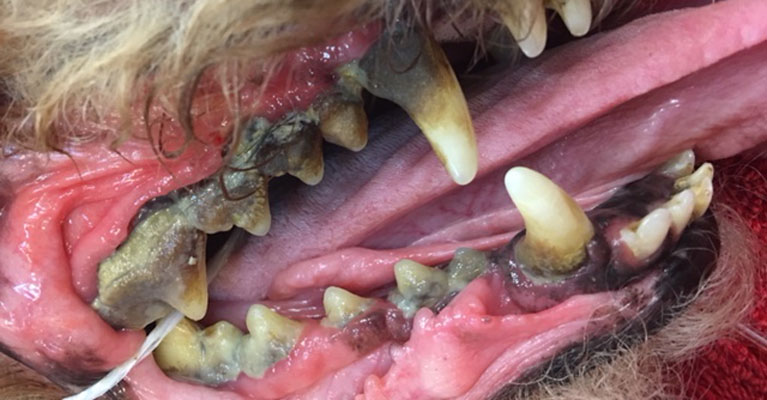

February is National Pet Dental Health Month and once again I am waging my yearly awareness campaign to help pet owners grasp and understand the significance of dental health as an integral component to the overall health of pets. Most of us engage in regular dental check ups and cleanings. Like me, many of us have been encouraged to commit to a consistent dental health regimen as the result of pain and suffering we experienced as a consequence of ignoring our teeth in the past.
Most of us do something about our poor dental health once the pain becomes too overwhelming to ignore. Pet owners that would normally never allow a second to go by with their pet in pain, commonly don’t pick up on their dental pain, because dogs and cats by their nature internalize their pain. They assume that since the pet is eating and not crying that all is well, even after the veterinarian during a check up points out dental decay, gum recession, and root exposure that would have long ago sent us begging for an appointment with the dentist.
But beyond the stress of pain and infection in the mouth, chronic, unchecked dental disease can compromise, even destroy organs, namely the heart, liver and kidneys. In a 2021 study published in NCBI, it was determined that the presence of chronic periodontal disease in dogs and cats that did not receive regular preventative dental hygiene procedures, had a 1.5 times higher incidence of kidney failure than dogs and cats that maintained healthy teeth and gums through dental health engagement.
When dogs and cats present with heart murmurs from congenital, inherited disease, we typically detect them at 3 years of age or younger. Therefore, when I hear a murmur suddenly arise at a time well into the adult or senior years, the first place I look is the teeth. More often than not, there is concurrent substantial periodontal disease and gingivitis. How does this correlate? Oral bacteria can travel via the blood stream and seed infection on the heart valves. Even if the infection does not cause full scale bacterial endocarditis, it can still exert serious damage by leaving scarring on the heart valves that compromise their seal; clinically manifesting as a murmur, while predisposing the patient to future heart failure.
The biggest obstacle I face with optimizing owner compliance with dental cleaning is pet owner fear of the anesthesia necessary to perform the cleaning. I will assure you that the pain, immune compromise, and reduced quality of life and longevity due to organ compromise that results from not having the teeth professionally cleaned, is far more dangerous for the pet than the anesthesia necessary to treat the problem.
2 Comments
Sandy Ellison
We just found out today that our Vet Dr. Welton is no longer at Grant Animal Clinic and are interested in possibly transferring our dog and cat to the new clinic. We had been having issues with Grant the past few months and was going to go back to our previous Vet. Wish we had known sooner.
Roger
Ms. Ellison,
Thank you for reaching out to us. Dr. Welton would be happy to see your pets her at Premier Veterinary Care. It is easily accessible, just 1 mile east of US 1 via Viera BLVD, or right off the I95 exit 193 interchange in the Winn Dixie plaza (right next to Dogtopia). Please feel free to give us a call any time to schedule a visit at (321) 361-4533.
Sincerely,
Sharon Mann
Practice Manager, Premier Veterinary Care